

A bearing is one of the most “invisible” parts of any machine — until it fails. Noise, heat, vibration and finally a damaged shaft or motor winding often start with one small mistake: the wrong bearing. There are three typical reasons a bearing wears out early: the wrong type or clearance, a poor-quality (counterfeit) product and incorrect mounting or lubrication. This article covers all three — and shows how to read a bearing number so you pick the right bearing the first time.
1. Bearing types — which one works where
Before reading the number, you need to know which type you need. In industrial equipment (electric motors, pumps, compressors, gearboxes, conveyors, machine tools) you will mostly meet seven types:
| Type | Number starts with | Where it is used | What it handles well |
|---|---|---|---|
| Deep groove ball | 60xx, 62xx, 63xx | Electric motors, fans, pumps, compressors | Radial load, high speed; light axial load |
| Tapered roller | 30xxx, 31xxx, 32xxx, 33xxx | Gearboxes, axles, machine-tool spindles | Heavy radial and axial load at the same time |
| Cylindrical roller | NU, NJ, NUP, N | Large electric motors, compressors, gearboxes | Very heavy radial load, high speed |
| Angular contact ball | 72xx, 73xx (B, C, AC) | Spindles, centrifugal pumps, ball screws | Axial load in one direction + radial; precision |
| Thrust ball | 511xx, 512xx, 513xx | Vertical shafts, support units | Axial load only, low speed |
| Needle roller | HK, NK, NA, RNA | Compact units with little space | Heavy radial load on a small diameter |
| Spherical / self-aligning | 22xxx, 23xxx; 12xx, 13xx | Vibrating machinery, conveyor pulleys | Shaft misalignment and vibration |
Rule of thumb: electric motors and pumps — deep groove ball (6xxx); gearboxes and axles with load in both directions — tapered (3xxxx); heavy radial load — cylindrical (NU). If the shaft and housing are not on one axis (misalignment) — spherical.
2. Roller bearings: tapered and cylindrical
When the load is heavy, a ball bearing is no longer enough: a ball touches the ring at a point, a roller along a whole line. Two roller types are the most common in industrial equipment.

Tapered (30xxx–33xxx) bearings consist of two parts — the inner ring with rollers (cone) and the outer ring (cup). They carry radial and axial load together, but axial load in one direction only — so they are mounted in pairs or with preload: in gearboxes, axles and machine-tool spindles. Numbering: last two digits × 5 = bore diameter (30212 → 60 mm). KOYO bearings often carry the suffix JR (KOYO’s own internal-design code) or HI-CAP (high-capacity series).
Cylindrical (NU, N, NJ, NUP) — the rollers are parallel to the shaft, so they carry very heavy radial load at high speed, but little or no axial load. The letters tell you which ring has ribs (the side shoulders that guide the rollers):
| Type | Ribs | Axial movement of the shaft | Where it is used |
|---|---|---|---|
| NU | Two on the outer ring, none on the inner | Free in both directions | Electric motors, compressors — paired with a ball bearing, for thermal expansion of the shaft |
| N | Two on the inner ring, none on the outer | Free in both directions | The same, where the free ring is better on the housing side |
| NJ | Two on the outer, one on the inner | Locked in one direction | Axial load in one direction |
| NUP | Two on each ring (one on a loose rib ring) | Locked in both directions | Locating the shaft |
The bore is read the same way: NU208 → 08 × 5 = 40 mm; the suffix E means a reinforced design with more rollers.
Tip: replacing an NU with an NJ or NUP “of the same size” is a common mistake — the shaft can no longer expand, the bearing is pinched axially and overheats. Both types are separable and their rings are mounted separately: do not mix the parts of a new bearing with an old one or with another set.
3. Decoding a bearing number — example 6208 ZZ C3
Metric numbers of ball and roller bearings follow one logic. Take the most common electric-motor bearing — 6208 ZZ C3:

| Part | Meaning |
|---|---|
| 6 | Type: deep groove ball bearing |
| 2 | Dimension series: 0 — extra light, 2 — light, 3 — medium (63xx is thicker and carries more than 62xx with the same bore) |
| 08 | Bore diameter: 08 × 5 = 40 mm |
| ZZ | Metal shields on both sides |
| C3 | Greater-than-normal radial clearance |
Bore diameter rule (last two digits):
| Code | 00 | 01 | 02 | 03 | 04 and up |
|---|---|---|---|---|---|
| Bore | 10 mm | 12 mm | 15 mm | 17 mm | code × 5 (05 → 25 mm, 12 → 60 mm) |
Common suffixes:
- ZZ / 2Z — metal shields on both sides. They do not touch the ring, so they are better for high speed; they keep out some dust, but not moisture.
- 2RS / 2RSR / DDU / LLU — rubber contact seals on both sides. Better in dusty and wet environments; the speed limit is noticeably lower (often by 30–40%).
- C3 — clearance greater than normal. Needed where the inner ring heats up and expands in operation — electric motors, compressors. Fitting a normal-clearance bearing instead of C3 in a motor is a frequent cause of “the new bearing got hot and seized”.
- CM — clearance selected for electric motors (between normal and C3) — for lower noise.
- B on angular contact bearings (7307 B) — 40° contact angle: carries more axial load than C (15°) or AC (25°).
- E on cylindrical bearings (NU208 E) — reinforced design, more rollers, higher load rating.
- W33 on spherical bearings — lubrication groove and holes in the outer ring.
- K — tapered bore (mounted on an adapter sleeve).
One full example: 6005-2RS CM = ball bearing, extra light series, 25 mm bore, rubber seals on both sides, motor clearance — a typical bearing for a small electric motor or fan.
4. If the number is worn off — select by dimensions
The number on an old bearing is often no longer readable. Then you need three dimensions:
- Bore diameter (d) — the shaft diameter, measured with a caliper;
- Outside diameter (D) — the housing bore;
- Width (B) — the ring width.

For example, 40 × 80 × 18 mm is one standard size and corresponds to 6208; 40 × 90 × 23 — to 6308. Three dimensions + type (ball/roller) + seal type = an unambiguous match. You can also search by dimensions in our online catalogue, or simply send us a photo and the dimensions.
5. Five questions to answer before choosing
- What load — radial, axial or both? Both → tapered or angular contact; radial only → ball or cylindrical.
- What speed? High speed → ball bearing with ZZ; low speed, heavy load → roller bearing.
- What temperature? Hot unit (motor, compressor) → C3; standard grease works up to about 120 °C.
- What environment? Dust, water, sawdust, cement → 2RS; clean and dry → ZZ or open.
- Are the shaft and housing aligned? Misalignment or vibration → spherical / self-aligning, or a housed unit (UCP/UCF) that compensates the misalignment itself.
6. Genuine or fake — why a “KOYO” is sometimes three times cheaper
The bearing market is one of the most counterfeited in the world. A fake bearing looks identical: the same box, logo, even laser marking. The difference is inside — steel quality, heat treatment, ball precision and grease.
A real case from our practice: a customer bought an “original” bearing for an electric motor from another source — much cheaper than ours. The new bearing failed within 3 months and stopped the motor. The result: not just the price of the bearing, but a production stop, a technician call-out and taking the motor apart and back together. A genuine bearing has been running in the same motor for years.
How to tell them apart:
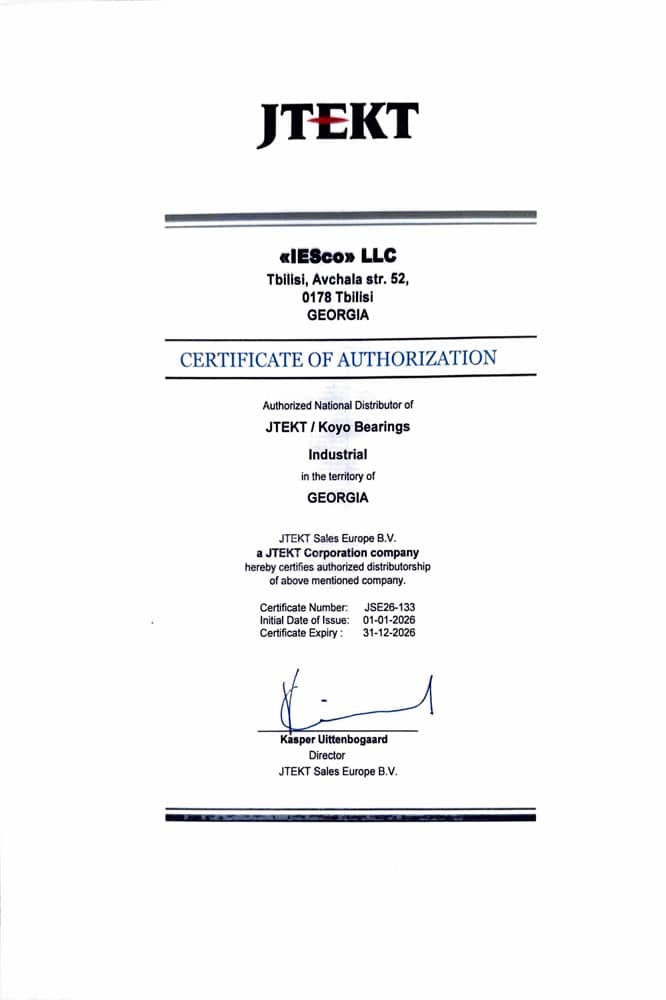
- Authorized source — the manufacturer’s official dealer documents the origin. IESCO is an authorized JTEKT (KOYO) partner in Georgia — see the certificate below.
- Price — if an “original” costs a third of the market price, it is not original.
- Marking and packaging — blurred laser marking, spelling mistakes on the box, no production code.
- Turn it by hand — a genuine bearing turns smoothly and quietly, a fake one feels “gritty”.
7. Five mounting and lubrication mistakes that kill a new bearing
Even a correctly selected bearing can die within months if:
- It is hammered directly on the ring — the balls leave marks and the bearing is noisy from day one. Use a bearing fitting tool or a press, and apply force to the ring that is being fitted (on a shaft — the inner ring, into a housing — the outer ring).
- Too much grease — only 30–50% of the free space inside the bearing should be filled. A bearing packed full runs hot: the grease cannot move, the balls churn it and the temperature rises. “More is better” does not apply here.
- The wrong grease — mixing lithium and calcium greases, or standard grease above 120 °C.
- A worn shaft or housing — a new bearing on a worn shaft “spins” in its seat and wears again. Check the shaft first.
- Heating with an open flame — heating the ring with an induction heater or in an oil bath up to 80–100 °C is acceptable, above 100 °C — never, and never with a torch: the steel loses hardness and the clearance changes.
Frequently asked questions
What do ZZ and 2RS mean on a bearing?
ZZ (or 2Z) — metal shields on both sides, for high speed; 2RS — rubber contact seals, for dusty and wet environments. The dimensions are identical, so one can replace the other if the conditions allow.
C3 or normal clearance — which one for an electric motor?
For electric motors and compressors, where the inner ring heats up — C3 (or CM). In cool, precise units (spindles) — normal clearance.
How long should a bearing last?
A correctly selected genuine bearing in an electric motor runs 20,000–40,000 hours (3–5 years of continuous operation). Failure within three months is almost always caused by a counterfeit product, the wrong clearance or incorrect mounting.
Can I replace one brand of bearing with another?
Yes — metric numbering is standard (ISO), and a 6208 from any manufacturer has the same size. What matters is quality and that the suffixes (shields, clearance) match.
Do you have them in stock?
Yes — our Tbilisi warehouse permanently stocks deep groove 60xx/62xx/63xx series, tapered 30xxx–33xxx, cylindrical NU, angular contact 73xx B, thrust 511xx and needle bearings. Send us the number or the dimensions — we will tell you availability and price the same day.
Conclusion
Choosing the right bearing comes down to four steps: type (what load and speed), size (the number or three dimensions), suffixes (shields and clearance for the environment and temperature) and source (an authorized dealer, not a “cheap original”). The rest is correct mounting and moderate lubrication.
If in doubt, don’t guess — send us a photo of the bearing, its number or its dimensions: ☎ +995 577 11 20 02, [email protected]. KOYO (JTEKT) bearings in stock → · Bearing catalogue →


