
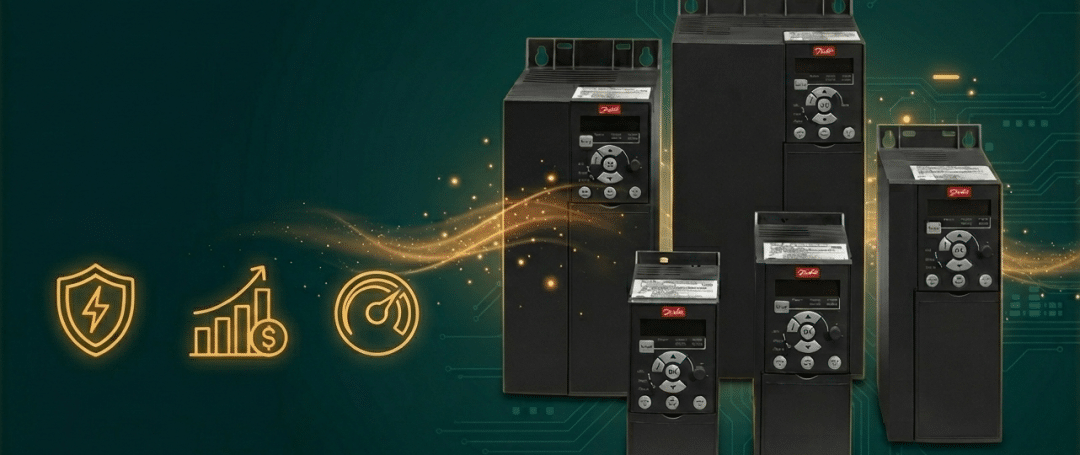
In modern manufacturing, electric motors are encountered almost everywhere, as they represent the driving force behind industrial processes. Variable Frequency Drives (VFDs) are used wherever motor speed regulation is required: in pumps for water supply and circulation systems, in fans and exhaust hoods to control airflow, on conveyors to vary production line speeds, in compressors to regulate air pressure, in mixers and stirring equipment, as well as in centrifuges, lathes, escalators, and many other machines. In such instances, it is crucial to ensure that the electric motor does not consume more energy than production requires.
This is precisely where the main protagonist behind the scenes, the Variable Frequency Drive, comes into play, whose role in motor control is invaluable.
In this blog, you will learn what a Variable Frequency Drive is and how you can use it to save costs, extend equipment lifespan, and fully control processes.
What is a Variable Frequency Drive?
A Variable Frequency Drive (also known as VFD) is a device that controls the rotational speed and torque of an electric motor by regulating the frequency and voltage of the incoming current.
The operating principle of a VFD is known as “double conversion” and is divided into three stages:
- Incoming alternating current (AC) is converted to direct current (DC)
- The direct current is filtered and stored in capacitors
- Finally, the inverter unit converts this direct current back into alternating current, but at the desired frequency and voltage.
The VFD’s controller acts as its brain, analyzing the motor’s status in real-time and adjusting parameters with microsecond precision.
How does a Variable Frequency Drive protect an electric motor?
The greatest enemies of an electric motor are sudden loads and sharp current fluctuations. These can damage windings and mechanical parts.
A VFD provides soft starting – the motor gradually accelerates, reducing mechanical stress and electrical strain. This means that:
- Bearings experience less wear
- Oil seals and gaskets last longer
- The risk of winding overheating is reduced
- Hydraulic shocks in pipelines are eliminated
Additionally, VFDs protect the motor from overload, voltage drops, and short circuits. They constantly monitor parameters and, if necessary, shut down the system before damage occurs.
Energy Savings – The Main Advantage
Energy consumption costs are constantly increasing. At the same time, reducing production costs is in the interest of every business. A VFD is one of the most effective ways to save energy.
For example, electric motors, fans, pumps, and air compressors often operate under partial load. A Variable Frequency Drive allows equipment to operate precisely in the mode required at any given moment and eliminates so-called “peak loads” during startup. This protects the electrical grid from damage and additionally saves resources. As a result, your energy costs are reduced by an average of 30 to 40%, and sometimes even by 50%.
Precise Control – The Key to Process Quality
Modern manufacturing demands precision. A Variable Frequency Drive allows you to precisely control:
- Pressure in air or water systems
- Flow rate
- Torque
- Acceleration and deceleration times
This is particularly important in high-precision processes where a small deviation can lead to product defects or equipment damage.
VFD Air Compressor – A Long-Term Partner
When discussing energy savings, it is essential to mention compressed air systems, especially if they operate continuously. In such cases, air compressors deserve attention because they consume a significant amount of energy.
A traditional air compressor constantly operates at maximum load, even when the line requires less air. A compressor equipped with Variable Frequency Drive technology automatically regulates motor rotation and consumes precisely the amount of energy needed at that specific time.
Advantages of a VFD-equipped compressor:
- Energy savings of up to 30-50%
- Pressure stabilization – pressure fluctuations are minimized, which improves the performance of all pneumatic components.
- Reduced wear – thanks to soft start and stop, mechanical parts are subjected to less stress.
- Noise reduction – at low RPMs, the compressor operates much more quietly.
- Leakage compensation – VFD instantly reacts to changes in air consumption, including in cases of leakage.
What to consider when choosing a Variable Frequency Drive?
If you decide to install a VFD, pay attention to the following factors:
- Motor type and power: The VFD must match your motor’s nominal current and power.
Note that different types of motors (asynchronous, synchronous, magnetic) require different control strategies.
- Operating environment conditions (temperature, dust, humidity)
- Communication protocols: Modern Variable Frequency Drives support Profibus, Modbus, Ethernet/IP, and other industrial networks, allowing integration into SCADA systems.
- Additional functions (integrated controller, energy meter, built-in filter)
- Support and service: It is important that a service center, spare parts, and technical consultation are available in the local market. In response to the latter, IESCO has the largest spare parts warehouse in the Caucasus, and at Avchala Street #52, you will find our service center and showroom, where you can purchase the necessary products or repair existing ones on-site.
IESCO offers:
Danish Danfoss Variable Frequency Drives. Danfoss Drives is a global leader in AC/DC and DC/DC power conversion technologies, whose Variable Frequency Drives feature integrated PLC functions, control logic, and MODBUS / PROFIBUS / BACnet communication.
If you are interested in how you can save energy using a VFD or need consultation on compressor modernization, contact us – our specialists will help you select the optimal solution for your production and provide professional support 24/7.


