
Air Blower
Blowers are machines that generate high-volume, low-to-medium-pressure air flow. They differ from compressors: a compressor squeezes a small volume of air to high pressure (7–10 bar), while a blower delivers a large volume of air at low pressure — continuously, around the clock.
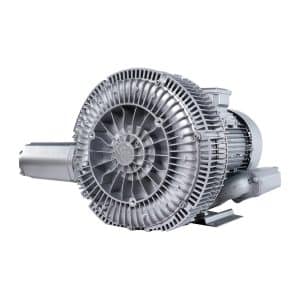
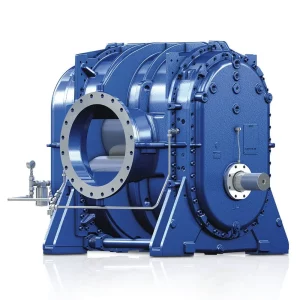
Our range has two blower families. AERZEN rotary lobe and screw blowers are the heavy industrial class, up to 1 bar, for treatment plants and pneumatic conveying. SOP ring (side channel) blowers are compact oil-free machines from 0.37 to 25 kW that deliver both pressure (up to 670 mbar) and vacuum (down to −460 mbar): aeration, vacuum tables, drying, light pneumatic conveying.
Showing all 2 results
Where Are Blowers Used?
- Water and wastewater treatment plants — aeration: supplying oxygen to the biological treatment process (aeration accounts for the largest share of a treatment plant's energy costs)
- Pneumatic conveying — transporting powdered and granular materials (cement, flour, granules) through pipelines
- Aquaculture — oxygenating the pools of fish farms
- Biogas plants — mixing and transporting biogas
- Vacuum and drying in production — vacuum tables on CNC machines, packaging and printing machines, air knives, medical and dental suction
Types
- Rotary (Roots-type) blowers — a durable classic for low-pressure tasks; simple design and easy maintenance. In our range: AERZEN.
- Screw blowers — the new generation: up to 20–30% lower energy consumption and reduced noise; optimal for facilities operating under constant load. In our range: AERZEN.
- Ring (side channel, regenerative) blowers — the impeller sits directly on the motor shaft, with no oil and no gearbox; one machine works both as a pressure source and as a vacuum pump. Compact and practically maintenance-free, 0.37 to 25 kW, 80 to 2050 m³/h. In our range: SOP 2LG.
Which type for which job
| Task | Type | Why |
|---|---|---|
| Treatment plant aeration, high flow 24/7 | Rotary or screw (AERZEN) | Up to 1 bar, thousands of m³/h, best energy efficiency under constant load |
| Fish farm, pool, small treatment unit | Ring blower (SOP) | Oil-free air, quiet, simple installation, low cost |
| Vacuum table, suction, vacuum lifting | Double stage ring blower (SOP) | Vacuum down to −460 mbar from the same machine, no wearing parts |
| Pneumatic conveying over long pipe runs | Rotary (AERZEN) or double stage ring (SOP) | Depends on material rate and distance — we do the calculation |
| Air knife, drying, bottle blow-off | Ring blower (SOP) | Clean air without oil traces at medium pressure |
Official AERZEN Representative in Georgia
IESCO is the official representative and partner of the German brand AERZEN (founded in 1864) in Georgia. You receive original AERZEN equipment, installation and service by brand-trained engineers, and locally available spare parts — without the risk of voiding your warranty. SOP ring blowers are supplied complete with filter, relief valve and silencer and are serviced by the same service centre.Selection
A blower is selected based on the required flow (m³/h), pressure or vacuum (mbar), and operating mode. IESCO's engineers will calculate your facility's parameters free of charge — from treatment plant aeration to a CNC vacuum table.Frequently asked questions
What is the difference between a blower and a compressor?
A compressor squeezes a small volume of air to high pressure (7–10 bar); a blower delivers a large volume at low pressure (up to 1 bar) continuously. For aeration and pneumatic conveying a blower is far more economical.
Ring blower or rotary blower — which should I choose?
For high flow (thousands of m³/h) and constant 24/7 load, a rotary or screw AERZEN. For compact duties up to 2050 m³/h, where vacuum is also needed or oil traces are unacceptable, a SOP ring blower. Tell us the m³/h and mbar you need and we will give you an exact answer.
Can a ring blower run as a vacuum pump?
Yes. The same machine works on pressure (up to 670 mbar) and on vacuum (down to −460 mbar); only the connection side changes. The two maximum values are not reached at the same time.
How often does a blower need service?
A ring blower has practically no wearing parts: periodic replacement of the inlet filter is enough. Rotary and screw blowers need scheduled service with oil, filter and belt changes, which our service centre carries out.
📞 Contact us: 577 11 20 02 · Technical questions: 577 42 88 70 · [email protected]