
Vacuum Pumps
A vacuum pump is essential equipment wherever the technological process requires vacuum — from packaging and the food industry to plastic forming, printing, and medical systems. IESCO offers vacuum pumps of various capacities, spare parts, and full technical service.
Showing the single result
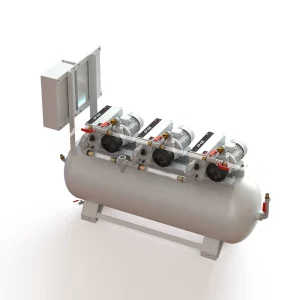
What is an industrial vacuum pump?
A vacuum pump is a machine that draws air (or gas) out of a closed volume and creates a pressure below atmospheric — a vacuum. Where a compressor "pushes" air, a vacuum pump "pulls" it — and that force drives hundreds of processes in modern production: packaging, forming, clamping, drying, casting.
Vacuum depth is measured in millibar (mbar): atmosphere ≈ 1,013 mbar, industrial "rough" vacuum 1,013–1 mbar, medium vacuum 1–0.001 mbar. 90% of production processes need rough vacuum, which is exactly what rotary-vane and scroll pumps provide.
Types of vacuum pumps
- Oil-lubricated rotary vane — the workhorse of industry: ultimate vacuum down to 0.5 mbar, 4–1,000 m³/h, simple, quiet, inexpensive; packaging, forming, woodworking, printing.
- Dry (oil-free) rotary vane — 150–200 mbar, no oil, where oil vapour is unacceptable or maintenance must be minimal.
- Liquid ring — for humid, dusty, aggressive gases: chemicals, food production, paper mills.
- Dry screw and claw — for heavy continuous duty and central vacuum systems.
- Side-channel blowers — high flow, shallow vacuum (300–500 mbar): CNC clamping, pneumatic conveying. See air blowers.
Where vacuum pumps are used
- Packaging — vacuum and MAP packaging in food production, thermoforming.
- Plastics and composites — thermoforming, vacuum infusion, extruder degassing.
- Woodworking and CNC — vacuum clamping of workpieces on the table.
- Printing and paper — sheet feeding, printing presses.
- Medicine and laboratories — central hospital vacuum, drying, filtration.
- Electronics, glass, metal — vacuum lifting and handling, casting, steel degassing.
How to select a vacuum pump
1. Ultimate vacuum (mbar) — the depth the process needs: packaging 5–10 mbar, CNC clamping 200–300, thermoforming 50–100. Choose a pump whose ultimate vacuum is several times deeper than required — then it works fast and efficiently at the operating point.
2. Pumping speed (m³/h) — how much air must be removed per unit of time: chamber volume, required evacuation time and leakage. For example, evacuating a 100 l chamber to 10 mbar in 20 seconds needs a ≈ 90 m³/h pump.
3. Gas composition — dry clean air (rotary vane), humid or vapour-laden (gas ballast or liquid ring), dusty (inlet filter), aggressive (stainless execution).
4. Duty — continuous 24/7 or cyclic; one large pump or a central system with several pumps and a vacuum receiver. More engineering tools — in the Engineer's Corner.
Operating a vacuum pump
An oil-lubricated vane pump needs three things: dedicated vacuum pump oil (changed every 500–2,000 hours), a clean inlet filter and an exhaust oil-mist filter. Vanes last 10,000–20,000 hours. IESCO's service centre performs scheduled maintenance, vane replacement and overhauls of vacuum pumps — with genuine spare parts.
Vacuum pump brands from IESCO
- GEVAC (Italy) — oil-lubricated and dry rotary-vane vacuum pumps from 11 to 300 m³/h with 0.5 mbar ultimate vacuum; medical and industrial series; IESCO is GEVAC's authorised partner in Georgia
Together with vacuum pumps IESCO offers vacuum receivers, filters, electric motors, oils and full service. Selection, delivery, installation and commissioning — throughout Georgia.
🎯 Not sure what pumping speed you need? 📞 Call us: +995 32 206 01 00 or visit our showroom at 52 Avchala St., Tbilisi.
Frequently asked questions about vacuum pumps
Oil-lubricated or dry vacuum pump — which should I choose?
An oil-lubricated vane pump gives deeper vacuum (0.5 mbar), is quieter and cheaper — the standard choice for packaging, forming and woodworking. A dry (oil-free) pump is chosen when oil vapour must not touch the product, when the pump often runs at atmospheric pressure (CNC clamping) or when oil changes are impractical.
What does "ultimate vacuum 0.5 mbar" mean?
It is the lowest absolute pressure the pump reaches in a closed system — removing 99.95% of the atmosphere. In a real process the pump works at the operating pressure (e.g. 10 mbar), and the ultimate vacuum determines how fast and efficiently it reaches that point.
How often should vacuum pump oil be changed?
On clean air — every 2,000 hours or 6 months; in humid or dirty processes — every 500–1,000 hours. Use only vacuum pump oil (low vapour pressure) — ordinary compressor oil worsens the vacuum and damages the vanes.
Why has the pump lost vacuum?
The most common causes: worn or broken vanes, contaminated or watery oil, a clogged inlet filter, a leak in the system, a closed gas ballast on a humid process. IESCO's service performs diagnostics on site.
Can one pump serve several machines?
Yes — a central vacuum system (pump + vacuum receiver + piping) serves several consumers at once and is often more economical than individual pumps. IESCO designs and installs such systems.
Do you have vacuum pumps and oil in stock?
Yes — common GEVAC models (20–100 m³/h), vanes, filters and vacuum oil are always in our Tbilisi warehouse; other models within 2–3 weeks. ☎ +995 32 206 01 00, showroom at 52 Avchala St.
