
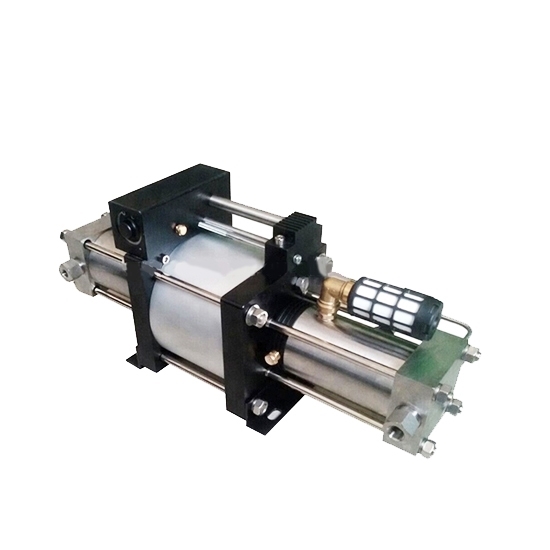
Description
An air pressure booster (air-driven gas booster) is a pneumatic piston pump that uses ordinary compressed air from the plant network as its drive and, without any electric motor, multiplies the pressure of the air or gas passing through it. A 5:1 booster fed with 8 bar of drive air delivers up to 40 bar at the outlet; a 40:1 unit reaches 300 bar and more. It is the simplest and safest way to obtain high pressure for a small consumer — a test bench, a cylinder, a laser nozzle — without installing a high-pressure compressor.
How it works
Inside the booster two pistons sit on one rod: a large drive piston and a small high-pressure piston. Drive air at 2–8 bar acts on the large piston; the force is transmitted to the small piston, and because force is the same while the area is smaller, the pressure in the small cylinder is higher by the ratio of the two areas. A pilot-operated spool valve reverses the drive air at each end of the stroke, so the unit cycles automatically as long as drive air is supplied.
Outlet pressure ≈ drive pressure × boost ratio (minus friction losses). When the outlet reaches the pressure set by the drive-air regulator, the forces balance and the booster simply stalls — it holds the pressure without consuming air and without any pressure switch or electronics. Lower the drive pressure and the outlet pressure drops accordingly; the outlet is therefore fully adjustable.
Boost ratio and typical outlet pressure (8 bar drive air)
| Boost ratio | Max outlet pressure | Typical flow | Typical use |
|---|---|---|---|
| 2 : 1 | ≈ 16 bar | up to 580 l/min | pneumatic tools and presses that need 12–16 bar |
| 3 : 1 | ≈ 24 bar | up to 420 l/min | moulding, clamping, small test rigs |
| 5 : 1 | ≈ 40 bar | up to 820 l/min | PET pre-blowing, laser assist gas, leak testing |
| 10 : 1 | ≈ 80 bar | 100–300 l/min | hydraulic accumulators, valve and hose testing |
| 20 : 1 – 40 : 1 | ≈ 160 – 320 bar | 10–100 l/min | cylinder charging, high-pressure nitrogen, burst tests |
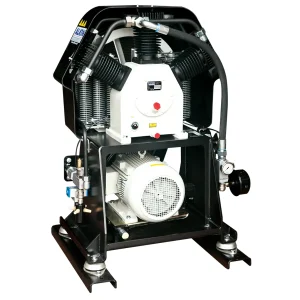
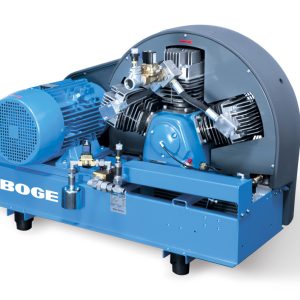
Flow falls as the outlet pressure rises — a booster is a low-flow, high-pressure device. For continuous consumption above ≈ 1 000 l/min at 40 bar an electric booster compressor (BOGE, ALKIN) is the better choice.
Advantages
- No electricity — no motor, no cabling, no starter; intrinsically explosion-proof, suitable for ATEX zones and wet areas;
- No heat — the gas is compressed slowly and stays cool; no cooling system required;
- Automatic pressure holding — the unit stalls at the set pressure and restarts by itself when pressure drops;
- Oil-free gas path — separate seals for drive and gas side; suitable for nitrogen, oxygen (dedicated version), argon, helium, natural gas and clean air;
- compact (a few tens of kilograms), no foundation, easy to move between test points;
- low price — a fraction of the cost of a high-pressure compressor.
Limitations to keep in mind
- Drive-air consumption is high: roughly 4–8 m³ of 7-bar air per 1 m³ of gas boosted — it makes sense for intermittent duty, not for continuous large flows;
- output flow depends strongly on inlet pressure — feeding the booster from a receiver at 6–8 bar (or from a nitrogen generator) gives the best result;
- the inlet gas must be clean and dry: a 5 µm filter and a dryer upstream are mandatory.
Applications
- pressure and leak testing of vessels, hoses, valves and pipe assemblies;
- charging gas cylinders and hydraulic accumulators with nitrogen;
- high-pressure nitrogen or air for laser cutting from a PSA nitrogen generator;
- gas transfer and scavenging of cylinders, laboratory and R&D installations;
- PET pre-forming, blow-off and clamping tasks that need 15–40 bar at a single station.
How to choose
Three numbers are enough: required outlet pressure, available inlet pressure (network or receiver) and flow or filling time. From these we calculate the boost ratio and the size (single- or double-acting, one or two stages), add the drive-air regulator, filtration, safety valve and gauges, and deliver the booster as a ready-to-connect unit.
IESCO offers
Air-driven boosters of the required ratio on request, complete with drive-air preparation, high-pressure fittings and safety equipment; integration with your compressor, dryer or nitrogen generator; commissioning and service in Georgia. Send us your pressure, flow and gas — we will size the unit and quote it.

Reviews
There are no reviews yet.