Boosters
A booster is a high-pressure piston compressor that takes the plant’s regular compressed air (7–13 bar) and raises it in one stage to 40 bar or more. Instead of running the whole network at high pressure, it feeds only the process that really needs it — so the energy cost is far lower than with a separate high-pressure compressor.
Typical applications: PET bottle blow moulding (30–40 bar), laser cutting and high-pressure nitrogen supply, pressure and leak testing, hydraulic and pneumatic test benches, industrial gas compression. IESCO selects the booster to match your pressure, flow and duty cycle, installs it on the existing compressed-air system and provides service in Georgia.
Showing all 3 results
What is a booster?
A booster (booster compressor) is a second-stage compressor: instead of atmospheric air it takes air or gas that is already compressed — usually from the plant network at 6–10 bar — and multiplies its pressure again: to 16, 25 or 40 bar, and with special models to 300 bar and beyond. A conventional screw compressor compresses economically up to 7–13 bar; everything above that is a booster's job.
The whole point of a booster is economics: instead of running the entire plant network at high pressure, high pressure is produced only for the one or two consumers that really need it. Every extra bar in the network costs roughly 6–7% more electricity — with a booster that cost applies only to the volume that actually needs it.
Types of boosters
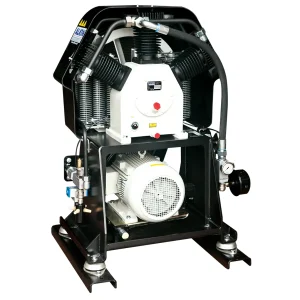
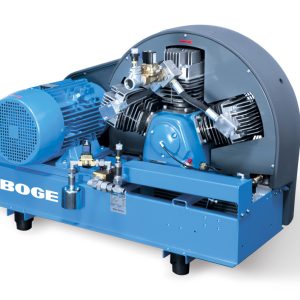
Electric piston booster — a one- or two-stage piston block driven by an electric motor. Inlet 5–10 bar, outlet up to 40 bar, 1,000–6,000 l/min. This is the industrial standard for continuous processes — PET blow-moulding lines, laser-cutting centres, production test benches. In the IESCO range this class is represented by the BOGE SRHV series (Germany) and the ALKIN 524/526/530 series (Turkey).
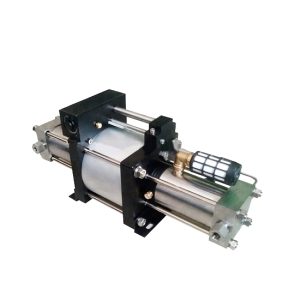
Air-driven booster (air pressure booster) — works without electricity: network air moves a large piston, the large piston drives a small one, and the pressure is multiplied by the ratio of the two areas — from 2:1 to 100:1. Meant for low-flow, high-pressure tasks: cylinder charging, leak testing, local nitrogen boosting. A detailed technical explanation is on the air pressure booster page.
Gas booster — the same piston principle, but for nitrogen, argon, helium and other gases; oil-free gas path and pressures up to 225–350 bar (e.g. ALKIN W3/W32).
Booster, high-pressure compressor or air-driven booster — which one?
| Criterion | Electric booster | Air-driven booster | Stand-alone high-pressure compressor |
|---|---|---|---|
| Pressure | 16–40 bar | 16–320+ bar | 30–350 bar |
| Flow | 1,000–6,000 l/min | 10–800 l/min | 100–3,000 l/min |
| Duty | continuous, 24/7 | intermittent | continuous |
| Energy cost at 40 bar | lowest (uses the existing 7–10 bar) | high (4–8 m³ of air per m³) | high (compresses from atmosphere) |
| Electricity | required | not required (ATEX) | required |
| Initial investment | medium | low | high |
A simple rule: continuous flow up to 40 bar — electric booster; high pressure occasionally and at low flow — air-driven booster; a high-pressure compressor only when there is no compressed-air network at all.
Where boosters are used
- PET bottle blowing — blow-moulding machines need 30–40 bar; a booster raises the plant's 7–8 bar network in one stage and saves 30–50% energy compared with a separate high-pressure compressor.
- Laser cutting — a clean, oxide-free edge on stainless steel and aluminium needs nitrogen at 20–30 bar. A PSA nitrogen generator delivers nitrogen at 6–8 bar, and a booster raises it to the laser's pressure — no cylinders.
- Pressure and leak testing — test benches for vessels, hoses, valves, fire extinguishers.
- Charging cylinders and hydraulic accumulators — with nitrogen, air or inert gases.
- Engine starting air, moulding, injection — wherever a single station needs more pressure than the network.
How to select a booster
1. Final pressure (bar) — what the consumer demands: PET blowing 35–40, laser 20–30, a test bench — according to the test standard. Choose a booster whose rated pressure is 10–15% above the requirement.
2. Flow (l/min) and duty — continuous consumption goes to an electric booster, intermittent (charging, testing) to an air-driven one. Remember that booster output depends on inlet pressure: from 10 bar the same unit delivers far more than from 5 bar.
3. Inlet pressure and air quality — a booster needs stable pressure from a receiver and dry air after a dryer, cleaned by filters — water and oil at high pressure quickly damage booster valves. Build the purity chain your process needs with our ISO 8573-1 configurator.
With these three figures IESCO's engineers will select the booster free of charge and prepare an energy comparison with the alternatives. More engineering tools are waiting in the Engineer's Corner.
Booster brands from IESCO
- BOGE (Germany) — SRMV/SRHV series, 5.5–18.5 kW, up to 40 bar; premium class for continuous duty
- ALKIN (Turkey) — 524/526/530 series up to 40 bar and W-series gas boosters up to 350 bar; best price/performance
- Air-driven boosters — 2:1 to 100:1, no electricity, on request
The complete system in one place: together with the booster we supply screw compressors, nitrogen generators, dryers, receivers, high-pressure piping and spare parts. IESCO covers the full cycle — selection, delivery, installation, commissioning and service throughout Georgia.
🎯 Want a booster matched precisely to your process? 📞 Call us: +995 32 206 01 00 or visit our showroom at 52 Avchala St., Tbilisi.
Frequently asked questions about boosters
What is the difference between a booster and a high-pressure compressor?
A high-pressure compressor starts from atmospheric air and does all the compression itself; a booster takes the network's already compressed 6–10 bar air and adds only the last stage. That is why a booster is smaller, cheaper and uses 30–50% less energy for the same flow at 40 bar — provided the plant already has a compressed-air network.
What pressure does PET bottle blowing need and which booster do I need?
Most blow-moulding machines need 30–40 bar. The typical solution is a 7–10 bar screw compressor + an electric piston booster to 40 bar (BOGE SRHV or ALKIN 524/530); the capacity is set by the machine's consumption — usually 1,000–4,000 l/min.
Can a booster raise nitrogen pressure for laser cutting?
Yes — it is one of the most common applications. A PSA nitrogen generator delivers 99.5–99.999% nitrogen at 6–8 bar, and the booster raises it to the 20–30 bar the laser needs. For nitrogen a booster with an oil-free gas path is selected.
How much energy does a booster consume?
An electric booster uses about 5.5–7.5 kW per 1,000 l/min at 40 bar — provided the inlet air is already at 7–10 bar. An air-driven booster uses no electricity but consumes 4–8 m³ of network air per 1 m³ of boosted gas, so it is economical only for intermittent duty.
What must be installed upstream of a booster?
A receiver (for pressure stability), a refrigeration or adsorption dryer and at least a 5 µm line filter — dry, clean inlet air multiplies the life of the booster's valves and piston rings. You can build the required chain with our ISO 8573-1 configurator.
Who installs and services the boosters?
IESCO — selection, delivery, integration with the existing system, commissioning and scheduled service throughout Georgia; spare parts for BOGE and ALKIN within 2–3 weeks, main ALKIN parts from stock. ☎ +995 32 206 01 00, showroom at 52 Avchala St.
