
Air Receiver (Vessel)
An air receiver (tank) is an essential component of a compressor system — it stores compressed air, stabilizes pressure, and reduces the number of compressor start-stop cycles, which directly extends the equipment’s service life.
Showing the single result
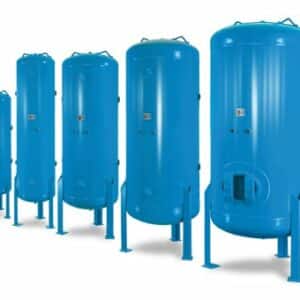
What is an air receiver?
An air receiver (air tank, vessel) is the buffer vessel of a compressed-air system, installed after the compressor. It does three jobs at once: it stores a reserve of air for peak demand, smooths pressure fluctuations and cools the air so that a large part of the condensate drops out right there. Without a receiver the compressor starts and stops constantly and the pneumatics run on unstable pressure.
The receiver is the cheapest component of a compressed-air system — and often the most underrated: a correctly sized tank extends compressor life and saves 5–10% of energy.
Why a receiver is essential
- Fewer load/unload cycles — a screw compressor runs in load/unload mode; the tank reduces the number of cycles, so the motor, contactor and unloading valve wear less. A piston compressor needs a tank even more — it protects the motor from overheating.
- Stable pressure — during sudden large consumption (sand blasting, a press, a blow-moulding machine) the tank covers the pressure drop.
- Condensate separation — air cools in the tank, most of the water collects at the bottom and is removed by an automatic drain, so the dryer is less loaded.
- Even with a VSD compressor a tank is needed — once the inverter reaches minimum speed, it is the tank that holds the pressure. How much a VSD saves — calculate here.
Types of receivers
Vertical — the most common: small footprint, condensate collects at one point. Horizontal — for installation under a compressor or in low spaces. Galvanised or internally coated — for humid environments and when the dryer is installed after the tank. Stainless steel — for food, pharmaceutical and medical systems. High-pressure (16–40 bar) — after boosters and on PET blow-moulding lines.
Volumes: 100, 270, 500, 900, 1,000, 2,000, 3,000, 5,000 and 10,000 litres; working pressure 11, 16 or 40 bar. Every tank comes with a safety valve, pressure gauge, condensate drain and inspection opening, certified to PED 2014/68/EU.
What size receiver do I need?
A practical rule for a screw compressor: tank volume (l) ≈ compressor capacity (l/min) × 0.3–0.5, i.e. a 2,000 l/min compressor needs a 600–1,000 litre tank. For a piston compressor — equal to or larger than the capacity. If consumption is peaky and uneven, choose a larger tank or add a second, "local" receiver at the consumer.
| Compressor capacity | Recommended tank (screw) | Recommended tank (piston) |
|---|---|---|
| 500 l/min (≈ 4 kW) | 270 l | 500 l |
| 1,000 l/min (≈ 7.5 kW) | 500 l | 900–1,000 l |
| 2,000–3,000 l/min (15–22 kW) | 900–1,000 l | 2,000 l |
| 5,000 l/min (37 kW) | 2,000 l | 3,000 l |
| 10,000 l/min (75 kW) | 3,000–5,000 l | — |
Position matters too: a "wet" receiver between the screw compressor and the dryer cools the air and relieves the dryer; a "dry" receiver after the dryer stores clean air. Build the right sequence for your purity class with the ISO 8573-1 configurator.
Safety and operation
A receiver is a pressure vessel: the safety valve must be set to the tank's maximum pressure, condensate must be drained daily (or by an automatic drain) and the tank inspected periodically for corrosion. IESCO supplies tanks as a ready assembly together with filters, automatic drains and aluminium piping. More engineering tools — in the Engineer's Corner.
IESCO offers
Air receivers from 100 to 10,000 litres at 11/16/40 bar — vertical, horizontal, galvanised and stainless — from European manufacturers, PED-certified and with full fittings. The main sizes are always in stock in Tbilisi. Selection, delivery, installation and service throughout Georgia.
🎯 Not sure what tank size you need? 📞 Call us: +995 32 206 01 00 or visit our showroom at 52 Avchala St., Tbilisi.
Frequently asked questions about air receivers
What size receiver do I need for my compressor?
For a screw compressor — 30–50% of the capacity in l/min: a 2,000 l/min compressor needs a 600–1,000 litre tank. For a piston compressor — equal to or more than the capacity. With uneven, peaky consumption choose a larger tank. IESCO's engineers will do the calculation free of charge.
Should the receiver be installed before or after the dryer?
Ideally both: a "wet" tank after the compressor cools the air and separates most of the condensate, a "dry" tank after the dryer stores clean air. With a single tank and a screw compressor it is usually placed before the dryer; with an adsorption dryer — after it.
What pressure rating should I choose?
For standard screw compressors (7–10 bar) — an 11 bar tank, for a 13 bar compressor — 16 bar, for a booster or a PET line — 40 bar. The tank's rated pressure must always be above the compressor's maximum pressure.
How often should condensate be drained?
Manually — daily, at the end of the shift; better an automatic (timer or level-controlled) drain that keeps the tank empty. Water left in the tank is the main source of corrosion and of moisture in the air line.
Does the tank need periodic inspection?
Yes — a receiver is a pressure vessel. An annual visual inspection, a safety-valve test and periodic technical inspection according to the operating rules are recommended. IESCO's service centre carries out these checks as part of scheduled maintenance.
Do you have tanks in stock?
Yes — 270, 500, 900 and 1,000 litre vertical tanks at 11/16 bar are always in our Tbilisi warehouse; other sizes and stainless/galvanised versions to order within 3–5 weeks. ☎ +995 32 206 01 00, showroom at 52 Avchala St.
