
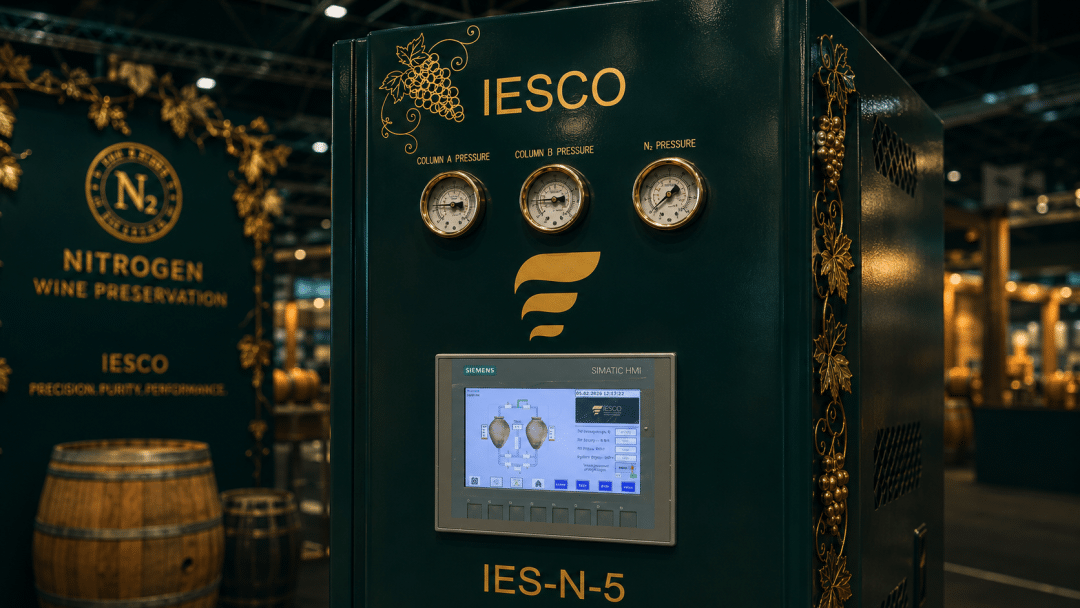
For years, AIESCO has participated in the international wine and spirits exhibition WinExpo Georgia, where we have gained friends, trust, and most importantly, honest conversations: winemakers tell us what works, what doesn’t, and what problems they face. Here, we offer advice, recommendations, learn about industry news, market challenges, and together with winemakers, we try to find solutions.
It is at this exhibition that for years we have been hearing about the same problem, which led us to one of the quietest and most costly challenges in Georgian winemaking. They came with stories of entire batches of wine, cultivated with immense effort, spoiling, and everyone had the same problem – nitrogen cylinders. The scenario is always the same: production was technologically sound, but the product still spoiled, and ultimately it turned out that neither people nor containers were to blame, but rather the purity of the nitrogen in the cylinder.
Why is nitrogen important for wine?
A small amount of oxygen is beneficial; it contributes to proper wine aging. However, oxygen is also one of wine’s main enemies, as excessive contact with air leads to oxidation: the wine loses its aroma, color, quality, and freshness. This is precisely why winemakers use nitrogen, but the question arises: how?
Nitrogen Purity in Wine Production
According to the Australian Wine Research Institute (AWRI), one of the most authoritative independent organizations in wine science, nitrogen used in wine production must be food-grade, with a minimum purity of 99.5%. This is the basic benchmark cited as the minimum quality for nitrogen (AWRI, Gas adjustment). But here’s the trap: 99.5% sounds like an “almost perfect” number, but in reality, it is the threshold below which the risk of oxidation sharply increases.
To this day, many wineries opt for cylinders instead of implementing a nitrogen generation system and nitrogen supplied on-site by a nitrogen generator. Nitrogen cylinder supply comes with several structural problems:
1. Purity variability depending on the supplier. One batch might be 99.9%, another 99.2%. This difference is often not even noted on the label, or it’s entirely based on trust.
2. Lack of verification capability. Typically, small and medium-sized enterprises do not have their own analyzer to verify the cylinder’s contents on-site immediately upon delivery.
3. Dependence on external suppliers. Every new delivery is a new variable that the producer cannot control.
You don’t see the result until the bottle is opened. This is what makes operations based on cylinder-supplied nitrogen particularly dangerous compared to typical production flaws. If the fermentation temperature mistakenly rises, you’ll notice it early through laboratory analysis or tasting. But if the cylinder nitrogen is of low purity, you only see the result when the consumer opens the bottle – that is, when it’s too late to fix anything.
And since many bottles are processed with one cylinder, the problem is never isolated; it spreads across the entire production batch. This means that due to one low-quality cylinder, hundreds or thousands of bottles could be at risk, and the producer will only receive this information after customer complaints begin or dissatisfaction with wine quality increases. This represents both a financial and reputational risk.
Nitrogen Generation System and Nitrogen Generator
That is why many wineries are switching from cylinders to on-site nitrogen generation systems.
What changes in this case:
- Purity is continuously monitored, not batch by batch. The system itself produces nitrogen from the air, to the required purity level, typically from 99.5% to 99.999%, as needed.
- No dependence on suppliers. The system produces as much as needed, at the quality required.
- Simplified costs and logistics. There is no need for constant ordering, transportation, storage, and changing of cylinders. Also, the price is stable, and you are no longer dependent on market fluctuations.
- Long-term stability.
Switching from cylinders to on-site generation gives winemakers much greater control over the process.
🔍 Learn more: The First Georgian Nitrogen Generator from AIESCO.
If you are still dependent on cylinders, it is best to ask yourself: How confident am I that the purity of the nitrogen in my cylinder is actually what the label promises?
If you don’t have an answer to this question, that’s reason enough to start exploring alternatives. Remember, true peace of mind begins when you know exactly what you are using, and not just hoping.
If this issue concerns you, or you are simply interested in how nitrogen generation works, contact us. Our team will provide you with comprehensive consultation to help you make more informed and sound decisions.
🔍 Learn more: 8 Questions You Should Answer Before Purchasing a Nitrogen Generator.


