
Compressors and Air Systems
Air compressors and compressed air systems are one of IESCO’s core business areas. This is a field where years of experience and a professional team help us deliver the best solutions to our customers.
Showing all 9 results
-

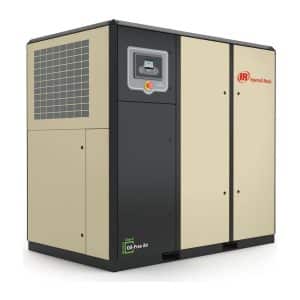
Ingersoll Rand Oil-Free Screw Compressors
-
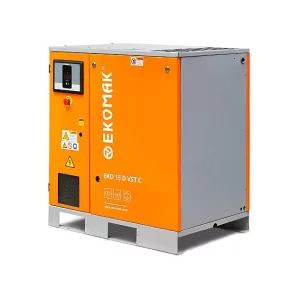
EKOMAK Screw Compressors
-
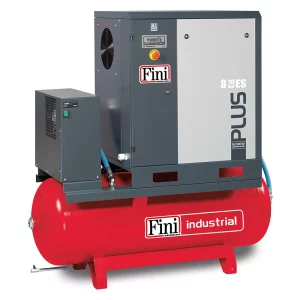
FINI Screw Compressors
-
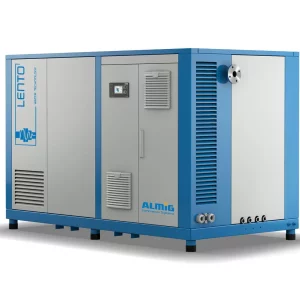
ALMiG Oil-Free Screw Compressors
-
Oil-Free Medical Compressors
-
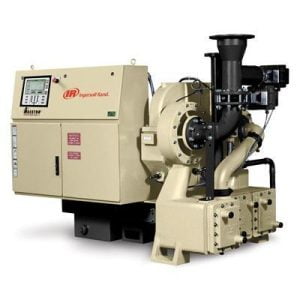
Oil-free Centrifugal Turbo Compressors
-
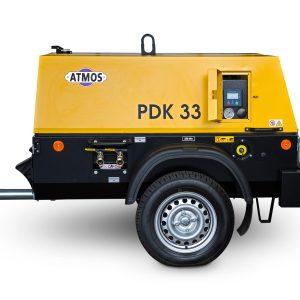
Mobile Compressors
-
Natural Gas Compressors
-
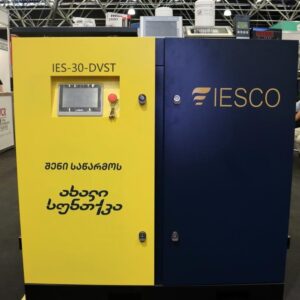
IES Screw Compressors
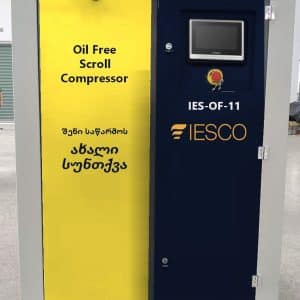
What Is an Air Compressor?
An air compressor is a machine that increases the pressure of air taken from the atmosphere by compressing it. The unit consists of a pump and a tank, whose volume and type determine the amount of pressure generated and the system's capacity. Compressed air is released from the system through a special valve.
Compressors differ from one another in power, design, and intended application. That is why, to best meet both individual and industrial needs, IESCO offers air compressors of various types and brands.
Why a Screw Compressor and Not a Piston One?
IESCO focuses exclusively on industrial screw compressors — piston technology belongs to the 20th century. In an industrial environment, a screw compressor outperforms a piston one in every parameter:
Continuous operation — a screw compressor is designed for 24/7 operation, while a piston compressor requires periodic breaks and wears out quickly under intensive load.
Energy efficiency — at the same capacity, a screw system consumes 15–25% less electricity, which adds up to significant savings over the years. Noise and vibration — a screw compressor runs much quieter, improving working conditions in the production space. Air quality — stable pressure and lower oil content in the compressed air, which is critical for pneumatic tools and technological processes.Why Air Compressors?
Air compressors give businesses the ability to control how much air they produce, at what pressure, and in what volume.
Generating your own air increases operational stability. Companies are no longer dependent on external suppliers, which reduces supply interruptions and costs.
Using compressors increases production efficiency, reduces equipment costs, and ensures process continuity.
Moreover, modern systems are highly energy-efficient, which significantly reduces operating costs in the long run. Over time, the initial investment in an air compressor fully pays for itself, while production processes become more reliable and economical.
How to Choose an Industrial Compressor?
Three key parameters need to be determined for the right selection:
Capacity (l/min or m³/min) — how much compressed air your equipment consumes in total. Insufficient capacity causes pressure drops, while excess capacity means wasted money.
Pressure (bar) — standard industrial equipment operates at 7–10 bar, while specific processes require higher pressure.
Operating mode — different configurations are selected for single-shift production and 24/7 continuous cycles, including models equipped with a variable speed drive (VSD) that adjust consumption to the load. Curious how much a VSD would save on your compressor? Find out with our free energy savings calculator.
IESCO's engineers will help you with precise calculations free of charge — they'll select the optimal model based on your production parameters. More engineering tools await you in our Engineer's Corner.
Air Compressor Brands
IESCO offers a wide selection of air compressors:- EKOMAK
- FINI
- INGERSOLL RAND
- VORTEX
- ALMIG
- RENNER
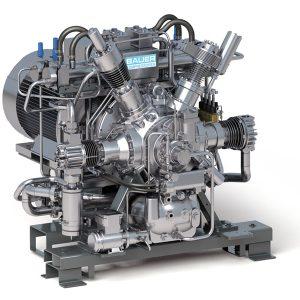
- BAUER
- ATMOS
- IES Series — IESCO’s signature series
We also offer air dryers — including IESCO's own IES-DRY series — air receiver tanks, compressor spare parts, air line filters, and everything you need to set up your compressed air system.
IESCO provides the full cycle: selection, delivery, installation, commissioning, and ongoing service across Georgia. Our service center performs scheduled maintenance and warranty support.
🎯 No matter which sector you operate in — IESCO offers efficient and reliable compressors tailored to you.
Want to select a compressor tailored precisely to your needs? 📞 Contact us: 032 206 01 00 or visit our showroom at Avchala 52 and see the models on display in person.
Compare for yourself: Load/Unload, VSD and IES Series
How much electricity does an air compressor use at your load? Choose the power, move the load slider and watch live where idle kilowatts are burnt in Load/Unload mode and how much a variable-speed drive and a PM motor save per year. Full version: compressor comparison.
Same job, three technologies. Choose the power, move the load slider and watch consumption, pressure and yearly cost change in real time.
Line pressure, bar
While loaded, Load/Unload pumps up to 8 bar (surplus capacity), then idles and the pressure falls back to 7 bar at the rate of consumption; the higher the pressure, the more kW. At 100% there is no surplus, so it runs loaded continuously. VSD and IES Series hold exactly 7.0. Time is slowed down for clarity.
Yearly saving vs Load/Unload, $
At 100% load VSD IE3 goes negative: the inverter losses are not recovered under constant full load. IES Series with its PM motor stays positive at every point.
Air Compressor FAQ
Which is better for my production — a screw or a piston compressor?
If your compressor runs more than 2–3 hours a day, the answer is clearly a screw compressor: it is built for continuous 24/7 operation, consumes 15–25% less electricity at the same capacity, and runs far quieter. A piston compressor is only justified for occasional, small-scale use.
How do I know what size compressor I need?
Add up the air consumption of all your pneumatic equipment (l/min), add a 20–30% reserve for the future, and check the required pressure (usually 7–10 bar). IESCO's engineers will do this calculation for you free of charge — get in touch.
What is a VSD (variable speed drive) and how much does it actually save?
A VSD matches the compressor motor's speed to demand instead of fixed start-stop cycles. In production with variable load this typically means 20–35% electricity savings. Calculate the exact figure for your machine with our free calculator.
When is an oil-free compressor a must?
Whenever compressed air directly touches your product or process: food and pharmaceutical production, electronics, laboratories, paint booths. These applications require ISO 8573-1 Class 0 purity, which only oil-free technology delivers. Build the right chain for your industry with our air purity configurator.
How often does a screw compressor need maintenance?
The standard interval is every 2,000–4,000 operating hours or at least once a year — with oil, filter and separator changes. IESCO's service center provides scheduled maintenance and 24/7 emergency callouts across Georgia.
Do you keep compressors and spare parts in stock?
Yes — core models, original spare parts and oils are always in stock at our Tbilisi warehouse. See them in person: showroom at Avchala 52, ☎ 032 206 01 00.
