
Screw Compressors
Industrial rotary screw compressors from 2.2 to 315 kW: EKOMAK (Atlas Copco group), FINI, ALMiG oil-free and IESCO’s own IES series. Continuous 24/7 duty, variable speed versions, warranty, installation and service in Georgia.
Showing all 5 results
-
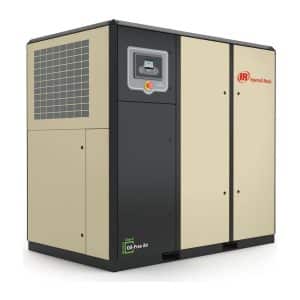
Ingersoll Rand Oil-Free Screw Compressors
-
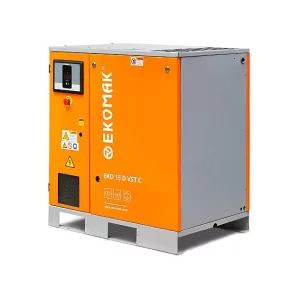
EKOMAK Screw Compressors
-
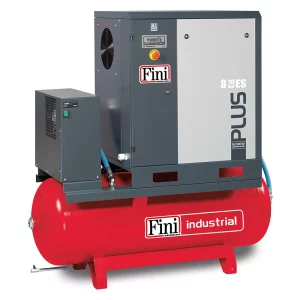
FINI Screw Compressors
-
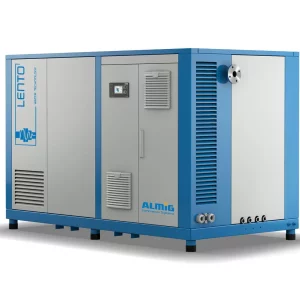
ALMiG Oil-Free Screw Compressors
-
IES Screw Compressors

What a screw compressor is and how it works
A rotary screw compressor compresses air with two intermeshing rotors turning in opposite directions. Air enters the rotor grooves at the inlet, the trapped volume shrinks continuously as the rotors turn, and the air leaves the outlet at the required pressure. The process is continuous, with no pistons, valves or dead points. That is why a screw compressor runs 24 hours a day without rest periods and is the standard air source in industrial production.
In an oil-injected machine, oil seals the gap between the rotors, cools and lubricates them, and is then separated from the air. In an oil-free machine the rotors never touch and the air never meets oil, which is critical for food, medical and pharmaceutical production.
Screw or piston: when to choose which
A piston compressor is cheap and adequate for small, intermittent use. In production duty it has three weaknesses: it runs intermittently and needs cooling pauses, it wears quickly under heavy load, and it uses more electricity for the same output. A screw compressor uses 15 to 25 percent less energy for the same flow, runs far more quietly and lasts 10 to 12 years.
A simple rule: if the compressor runs more than 4 hours a day, or production stops when it stops, you need a screw machine. See the detailed comparison in Screw or piston air compressor.
How to choose a screw compressor
Flow (m³/min). Add up the consumption of every tool and machine that runs at the same time, then add a 20 to 30 percent reserve for leaks and future expansion. An oversized compressor wastes energy idling; an undersized one runs flat out and wears fast.
Pressure (bar). Take the pressure of your most demanding consumer plus line losses, usually 7 to 8 bar, and no more. Every extra bar raises electricity consumption by roughly 6 to 7 percent.
Power (kW). This follows from flow and pressure. Our range runs from 2.2 kW to 355 kW, from a single workshop to a large plant.
Variable speed drive (VSD). If demand changes through the day, an inverter compressor adjusts motor speed to demand and avoids idling. In that duty the saving reaches 30 to 40 percent. Under constant, even load a fixed-speed machine is more economical. Estimate your saving with the energy savings calculator.
Oil-free or oil-injected. If compressed air touches the product, in food production, medical gas, pharma or electronics, choose an oil-free model. Otherwise an oil-injected screw compressor with proper filtration is entirely sufficient and more economical.
Our screw compressors
EKOMAK. An Atlas Copco group brand, 2.2 to 315 kW. The DMD series is compact with belt drive; the EKO series has direct drive and variable speed versions. Our widest line.
FINI. An Italian brand since 1952. MICRO, PLUS, K-MAX and TERA series from 2.2 to 250 kW, for small and medium plants.
ALMiG oil-free. German oil-free screw compressors for critical industries where even a trace of oil in the air is unacceptable.
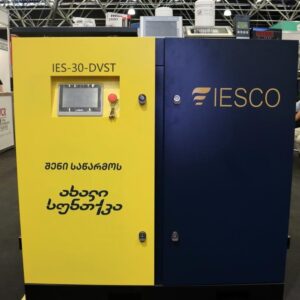
IES series. Built to IESCO's own technical specification, engineered in Georgia and tested extensively. Service and parts are on site.
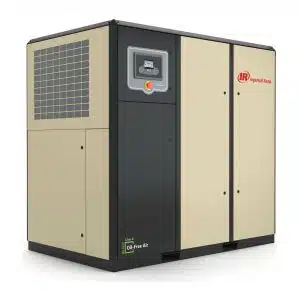
Ingersoll Rand oil-free. 100% oil-free screw compressors from the American brand, 15–355 kW, ISO 8573-1 Class 0. Water-injected E15-37H and dry two-stage Sierra, Nirvana, ES and E series, fixed and variable speed.
The system around the compressor
A compressor alone is never a system. Downstream sit an air dryer that removes moisture, line filters that stop particles and oil aerosol, and a receiver that smooths peak demand. Building this chain correctly matters as much as choosing the compressor itself.
Service and spare parts
The life of a screw compressor depends directly on regular maintenance: oil, air and oil filters, separator, belts. Our service centre handles scheduled and emergency work, and spare parts and oils are available for every brand we represent.
Compare for yourself: Load/Unload, VSD and IES Series
How much electricity does a screw compressor use at your load? Choose the power, move the load slider and watch live where idle kilowatts are burnt in Load/Unload mode and how much a variable-speed drive and a PM motor save per year. Full version: compressor comparison.
Same job, three technologies. Choose the power, move the load slider and watch consumption, pressure and yearly cost change in real time.
Line pressure, bar
While loaded, Load/Unload pumps up to 8 bar (surplus capacity), then idles and the pressure falls back to 7 bar at the rate of consumption; the higher the pressure, the more kW. At 100% there is no surplus, so it runs loaded continuously. VSD and IES Series hold exactly 7.0. Time is slowed down for clarity.
Yearly saving vs Load/Unload, $
At 100% load VSD IE3 goes negative: the inverter losses are not recovered under constant full load. IES Series with its PM motor stays positive at every point.
Frequently asked questions about screw compressors
What size screw compressor do I need?
Power follows from flow and pressure. Add up the consumption of the tools that run at the same time in m³/min, add a 20 to 30 percent reserve and tell us the pressure you need. We will select the exact model from that.
How much more economical is a screw compressor than a piston one?
It uses 15 to 25 percent less electricity for the same output. With variable speed drive and fluctuating load the saving rises to 30 to 40 percent.
How noisy is a screw compressor?
Far less than a piston machine. Thanks to its sound-insulated enclosure it can stand in the production area next to staff, without a separate building.
When is an oil-free screw compressor necessary?
When compressed air is in direct contact with the product or with people: food and beverage production, medical gases, pharma, electronics. Otherwise an oil-injected model with proper filtration is sufficient.
How often does a screw compressor need service?
Typically every 2,000 to 4,000 running hours, depending on model and conditions: oil, filters and separator change. Scheduled service extends the life to 10 to 12 years.
